Bitcoin price today in USD
This page shows the dollar price of Bitcoin as it moves, drawn from a TradingView chart embedded on the page; the site does not set or print a price of its own, and the feed can lag the market. Use it to see where BTC is trading against USD, then compare that with the naira pages if you think in local currency. Nothing here is a forecast, and the chart alone is not a reason to trade.
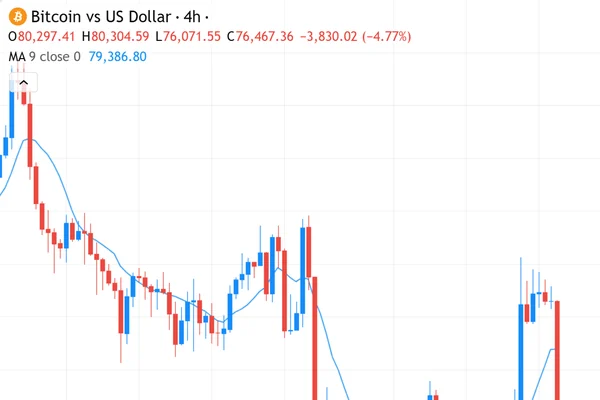
Bitcoin: chart
Chart by the TradingView widget; the data may be delayed, see its page.
The price is drawn here by the TradingView widgetThe price widget did not load
If nothing appears, the exchange shows the same quote on its own page.
Quote at the exchangeBTCUSD on bitstamp.netOpen the widget source on TradingView- Currency
- USD
- Price on this page
- TradingView widget, delayed
What the chart on this page shows
The main panel plots the Bitcoin price in US dollars as a line or as candles, depending on the view you pick. Price is read off the upright scale, while the sideways scale carries time.
Buttons above the chart let you change the timeframe, so you can look at a few hours, a few days or a much longer stretch. Switching between short and long views changes what the same price movement looks like, which is why a fall that seems sharp on a short setting can look minor on a long one.
Hovering with a mouse, or tapping on a phone, brings up the value recorded at that particular moment. Treat that reading as a snapshot of the feed, not as a live quote you can trade on, because the widget can trail the market by some margin.
Should the chart stay blank, the TradingView link beneath it opens the same chart. A blank panel is usually a loading problem on your side, so check your internet connection or reload the page before assuming the market has stopped.
Why there is never one single price
Bitcoin trades on many separate marketplaces at once, each with its own pool of buyers and sellers. The last trade done on one venue is not the last trade done on another, so the quotes sitting on different order books can disagree at any given moment. What you see as "the" price is really just the most recent match on the feed you happen to be watching.
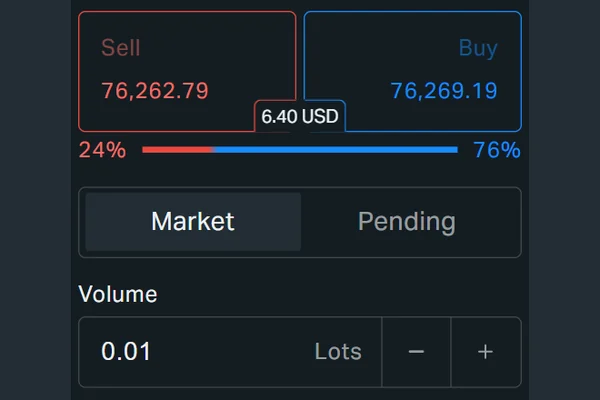
Every marketplace also quotes two sides. The buy quote and the sell quote differ by a spread, which is the gap between what a buyer offers and what a seller asks. That spread widens when trading is thin and narrows when it is busy, so the same coin can look slightly more expensive on one venue than another without anything being wrong.
Depth is the plain way to describe how much buying and selling sits at nearby prices. A deep market absorbs a large order with little movement; a shallow one can jump on a modest trade. When you compare figures, match the same pair and the same timeframe, because a USD quote and an NGN quote, or a short view and a long one, are not like for like.
Small gaps between venues are ordinary and reflect separate order books. A wide gap that persists is worth treating as a warning: it can point to thin trading, a feed lagging the market, or a venue under strain.
What moves the price
At the simplest level, price is the balance between buyers willing to pay and sellers willing to accept. When demand outpaces supply at a given level, the match moves up; when sellers dominate, it moves down. News that shifts mood, such as a change in how a major market treats crypto or a public statement from a large institution, can tilt that balance quickly.
Thin trading makes moves sharper. At weekends and during the night, trading can be thinner, so a modest order can shift the quote more than it would at a busy hour. Large holders matter too: a single big sale or purchase can move the order book, and traders watch wallet activity for hints of that.
Wider markets feed through as well. When investors move money between assets, or when the dollar strengthens or weakens against other currencies, Bitcoin may react. The pace of trading itself counts: a burst of activity can push price further than the same volume spread over a quiet day.
None of these forces can be predicted reliably, which is why charts show the past rather than the future. This site makes no forecast; if you want to understand how people attempt to predict where Bitcoin might go, read that guide with a clear head about its limits.
Using the page before you act
Before you act on anything you see here, run through a short routine. It takes a few minutes and it keeps a single chart from making a decision for you.
- Switch the timeframe to a short setting, then to a long one, and note whether the two tell the same story.
- Write down the time you took the reading, so you can tell later how stale it was.
- Compare the figure with the quote on the platform you actually use, since the chart feed can trail the market.
- If you think in local currency, open the naira page, remembering it is built from two charts: Bitcoin in USD and the dollar against the naira.
- Count every cost on your chosen route, from the spread to the transfer charge on your mobile banking app, before you judge the price attractive.
- Decide later, not in the moment, and give yourself room to check again once the feed has caught up.
Be clear about what this page cannot do. It has no converter, so you must work out any conversion yourself from the two charts. It sends no alerts, so nothing will warn you when the price moves. It offers no advice, and no figure on it is a signal to buy or to sell.
If you are new to peer-to-peer trading, read the steps carefully and start with a small test transfer before committing a larger sum.
The market does not close
Bitcoin changes hands around the clock, including through the night, at weekends and on public holidays. There is no bell that opens or closes it, so no official closing price exists to compare one day with the next.
A figure you note in the morning can be out of date by evening, and often is. Read the chart again at the moment you actually act rather than relying on a reading taken hours earlier.
Quiet periods can still surprise. A calm weekend does not mean a calm price, because thin trading lets a modest order move the quote further than it would on a busy day.
For how the pair itself is read, see the page on Bitcoin in dollars.
Bitcoin: basics
- Market
- BITSTAMP · BTCUSD
- Founded
- 2009Wikidata
Coin profile from Wikipedia and Wikidata (fetched 05.11.2026); it may lag behind recent changes.
More guides
 What is Bitcoin and how does it workBitcoin is a digital currency that exists only as records on a network of computers, and no central bank or…
 How to buy Bitcoin in Nigeria: the steps and the checksBuying bitcoin in Nigeria starts with deciding where the coins will come from, because the route you pick shapes…
 How to sell Bitcoin in Nigeria: the steps and the checksSelling bitcoin in Nigeria is mostly a matter of process. You pick a venue you trust, complete its checks, compare…
Read next: Prices · Bitcoin to dollar: how the BTC/USD rate works · What is Bitcoin and how does it work